Pulled a card? Here are the real answers.
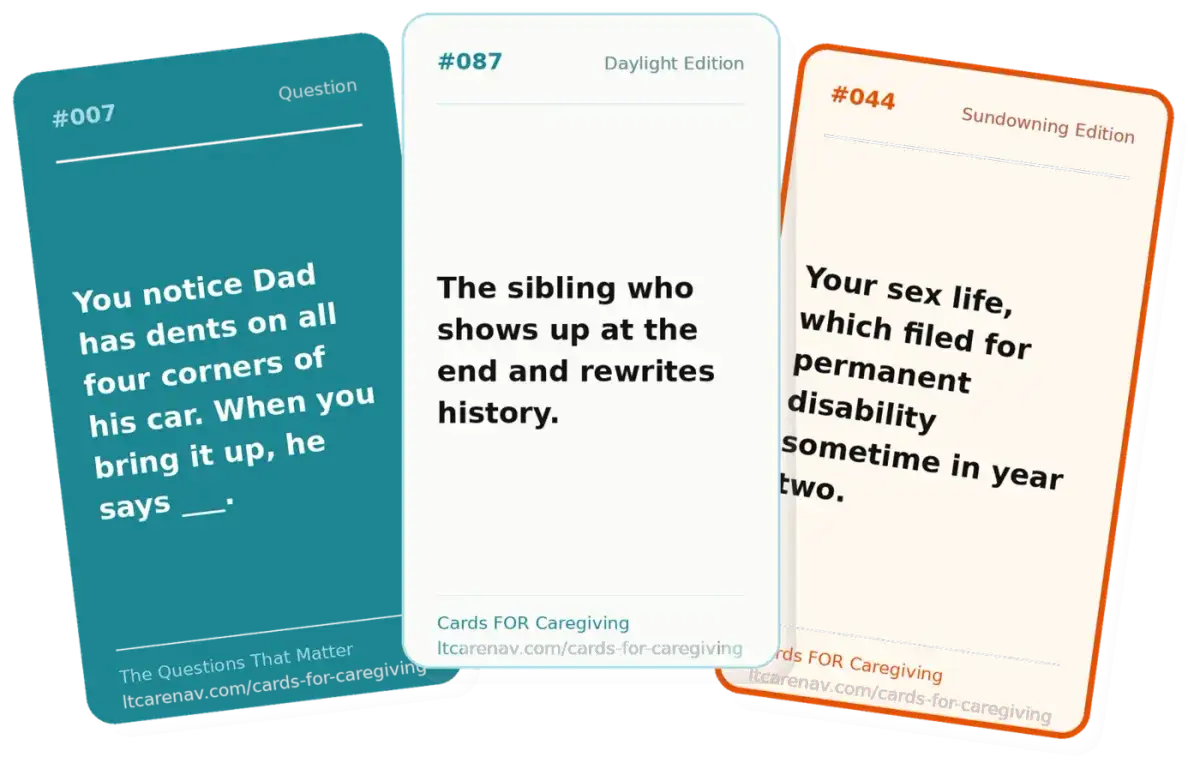
Every teal Question That Matters card in the deck is a short, conversational prompt — but the real question (and the real answer) lives in The Questions That Matter: A Family Guide to Aging, Care, and Planning by Lindsay Friedman. This hub is where families come after the laughter dies down to find the calm, expert-backed answer to the conversation the card just started.
Part One — Recognition & Planning
Chapter 1 — Noticing the Subtle Shifts
The thing that has quietly gotten harder this year that nobody has named out loud yet is ___.
The part of the house that has become a secret obstacle course is ___.
The household task that has been quietly abandoned for longer than anyone will admit is ___.
Mom has 11 prescription bottles on the counter and no idea what half of them are for. The plan is ___.
Dad paid the electric bill four times this month and cannot figure out why his bank account is low. The first step is ___.
Mom has not left the house in three weeks and says she just prefers it this way. What is actually happening is ___.
You notice Dad has dents on all four corners of his car. When you bring it up, he says ___.
Chapter 2 — Staying Steady — Mobility, Falls & Physical Safety
Dad insists he does not need a cane. He also grips every piece of furniture walking through the house. The phrase for this is ___.
You try to get your parent to use a walker. They compare it to ___.
The throw rug that has been a tripping hazard since 2003 and will never be removed because ___.
Dad's bedroom is upstairs, laundry is in the basement, and his plan if stairs become impossible is ___.
Mom has worn the same backless slippers since 1987. When you suggest new shoes, she says ___.
Nobody in this family has talked about who will help with bathing or dressing if the time comes. The reason for that silence is ___.
Chapter 3 — Who Will Walk This With Me? — Building Your Circle of Support
You ask your sibling to help with caregiving. Their response is ___.
Mom insists she has plenty of support. That support is ___.
Since the divorce, Mom's backup plan for who will take care of her is ___.
Nobody has talked about who will help with intimate care. The reason everyone keeps avoiding it is ___.
The family meeting to discuss Dad's care lasted three hours and accomplished ___.
You live 900 miles away and your sibling lives 20 minutes from Mom. Their contribution so far has been ___.
When you ask Mom who would notice if something was wrong, she thinks for a long time and says ___.
Nobody told the dog about the care plan. The dog's position on the matter is ___.
Chapter 4 — The Documents That Speak for You
Your parent chose the least organized sibling as financial power of attorney because ___.
The person named as healthcare power of attorney has never been inside a hospital. Their plan is ___.
Dad named one sibling over the others and told no one why. The story the other siblings are telling themselves is ___.
The will exists. Nobody knows where it is. The filing cabinet contains ___.
The person your parent most wanted as power of attorney said they could not do it. The reason was ___.
The family situation is complicated in a way that the standard estate planning forms did not anticipate, specifically ___.
Chapter 5 — Understanding the Costs — What Care Actually Costs and How to Pay for It
Mom thinks Medicare covers everything. When you explain it does not, her face does ___.
You ask your parent how long they could afford assisted living. After a long pause, they say ___.
Dad's plan for paying for long-term care is ___.
You try to explain the five-year Medicaid lookback period to your parent. They respond with ___.
Dad bought long-term care insurance in 1998 and thinks it covers ___.
The financial planner asked how much your parents have saved. Mom looked at Dad. Dad looked at ___.
Chapter 6 — Family Money Conversations — Fairness, Contributions & Hard Truths
If care costs became very high, Dad's stated priority would be ___.
Mom and Dad have never discussed what happens financially if one of them needs expensive care. The reason is ___.
Mom says she would never want her children to contribute financially to her care. What she actually hopes is ___.
The siblings finally talked about Mom's finances. What came out of that conversation was ___.
One sibling is doing 90% of the caregiving. The other siblings' explanation for this is ___.
The question of whether caregiving should affect inheritance caused the family to ___.
Mom refuses to tell anyone how much money she has because ___.
Part Two — Major Decisions
Chapter 7 — When It's Time to Move — Housing, Safety & Letting Go
Dad says he can absolutely still live alone. The evidence to the contrary includes ___.
Mom wants to stay in her home as long as possible. Her actual plan for making that happen is ___.
You try to explain the difference between assisted living and a nursing home. Dad hears ___.
You tour an assisted living community with Mom. Her first reason for ruling it out is ___.
Mom agrees to consider moving but cannot let go of the house because ___.
Dad says he is being pressured to move. What he means by pressure is ___.
Chapter 8 — Memory Loss — The Conversation No One Wants to Have
You notice Mom told the same story three times at dinner. Dad's response is ___.
Dad has been worried about his own memory for months and has told no one because ___.
You gently suggest a memory evaluation. Dad says he does not need one because ___.
After the dementia diagnosis, the first thing Dad asks about is ___.
Mom keeps leaving the stove on. Dad's solution to this problem is ___.
You try to take the car keys after the dementia diagnosis. What happens next is ___.
Chapter 9 — When Crisis Hits — The Call, The Hospital, The Decisions You Have to Make Now
You get the call at 6am that Dad is in the ER. Your first coherent thought is ___.
The discharge planner says Dad cannot go home. She says it with the energy of ___.
The hospital social worker hands you a list of rehab facilities to choose from in 4 hours. You ___.
You are managing Dad's crisis from 800 miles away. What is actually happening at home is ___.
Your siblings all have different opinions about Dad's care plan. The group text has become ___.
Chapter 10 — End of Life — Hospice, Final Wishes & Letting Go
Nobody in this family has talked about end-of-life wishes. The reason that conversation keeps getting delayed is ___.
The hospice nurse explains what the process will look like. What Mom hears is ___.
The oncologist says further treatment is unlikely to help. Dad's response is ___.
Your siblings disagree about end-of-life care. What actually gets decided is ___.
When asked what they want their last days to look like, your parent says ___.
Mom's advance directive says no heroic measures. The family's interpretation of heroic is ___.
Part Three — For the Caregivers
Chapter 11 — Caregiver Survival — Burnout, Boundaries & the Breaking Point
The moment you realized you were burning out was when you ___.
You finally say no to a caregiving request. The guilt sounds like ___.
You have not asked for help because ___.
Your marriage during caregiving can best be described as ___.
You took one afternoon off for yourself and spent the entire time ___.
You promised you would never put your parent in a facility. The thing that made you reconsider was ___.
Chapter 12 — When the Relationship Was Never Easy — Caring for a Difficult Parent
Your estranged parent suddenly needs care. Your first reaction is ___.
The parent who was abusive now needs your help. The thing nobody prepares you for is ___.
Caring for a manipulative parent looks like ___.
You set a boundary with your parent. Their response is ___.
You feel relief when you think about your difficult parent's death. The guilt sounds like ___.
Your family says to forgive and forget. What you actually feel is ___.
Chapter 13 — When Siblings Won't Help — Conflict, Resentment & Going It Alone
Your sibling who lives 10 minutes away has visited Dad twice this year. Their excuse is ___.
The sibling who does nothing has opinions about everything. Their latest critique is ___.
Your parent tells each sibling a different version of events. The version they told you is ___.
You have decided to stop covering for your sibling's absence. The first thing that happens is ___.
The family conflict during caregiving has gotten bad enough that you have started ___.
Family caregiving meetings with your siblings always end with ___.
When the caregiving finally ends, the first thing you feel is ___ and the second is ___.
Cards FOR Caregiving is a party game that gets families talking.
Cards FOR Caregiving is a party game for 4+ adults. One player is the Card Czar and reads a teal Question That Matters card aloud. Everyone else plays their funniest Daylight Edition white card — or a cheekier Sundowning Edition orange card — face-down. The Czar picks the best answer, and that player wins the round.
The point isn't to win. The point is to laugh, then to talk — about aging, money, memory, and the things families never quite get around to.
- 1Read a teal card
One player is the Card Czar and reads a Question That Matters card aloud.
- 2Play your white or orange card
Everyone else plays their funniest Daylight white card — or a cheekier Sundowning orange card — face-down.
- 3Czar picks a winner
Best answer wins the round. Then the real conversation starts — and that's where this hub comes in.
You've got the cards. The book goes deeper.
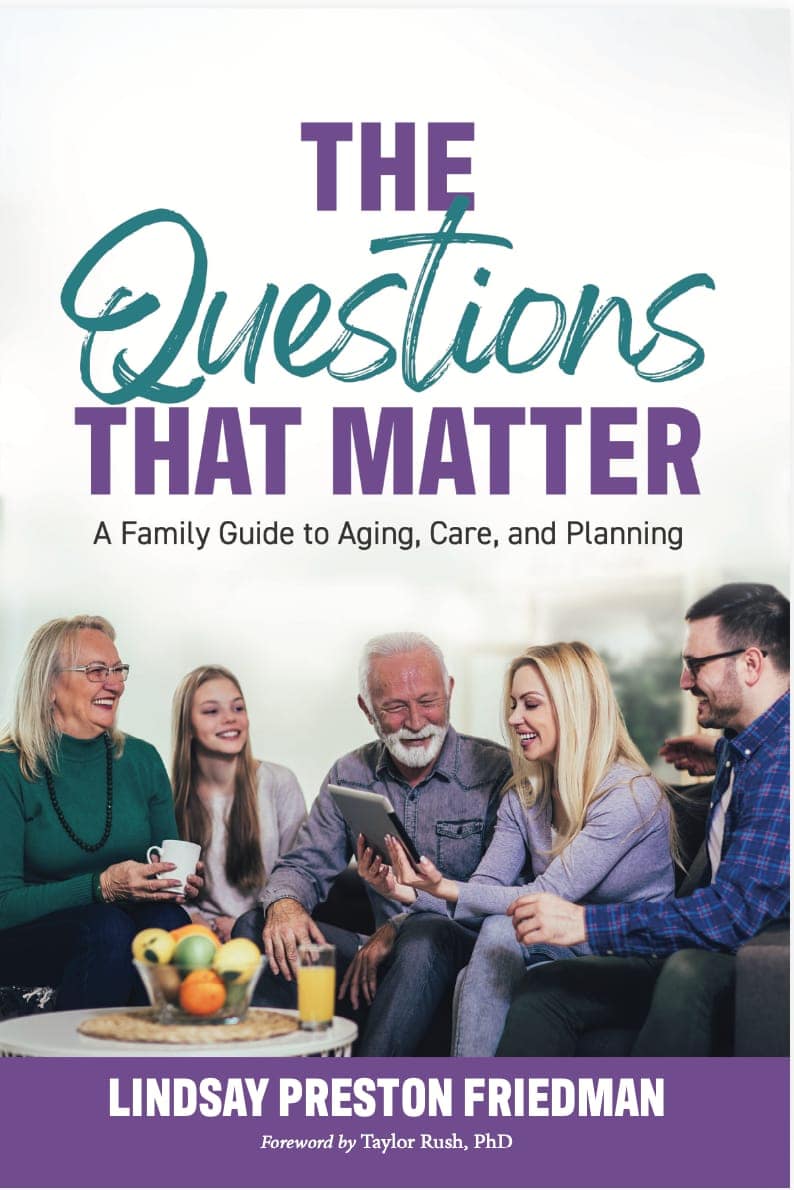
Every card is a doorway. The Questions That Matter: A Family Guide to Aging, Care, and Planning is the full guide behind the deck — the chapter, the context, and the next conversation for every prompt you've already started at the table.
Turn this question into your own plan.
Reading the answer is one thing — knowing what it means for your family is another. Get a free, personalized Care Plan in minutes. No pressure, no sales calls, just the next right step for where you are today.
Get Your Free Care PlanFree forever · No credit card · Founded by Lindsay Friedman