Many people with dementia want to stay in their own home as long as possible. And for a time, with support, that can work. But dementia creates safety risks that cannot be ignored — and the families who keep their loved ones safest at home are the ones who confront each risk head-on, early, before a crisis forces the issue.
**Wandering.** Roughly 6 in 10 people with dementia will wander at some point, and they can become lost even on streets they have lived on for fifty years. Wandering can turn fatal within hours, especially in extreme weather. Address it before it happens: install door alarms or chimes, place deadbolts high or low (out of the usual eye-line), use motion sensors at exits, and enroll the person in MedicAlert + Alzheimer's Association Safe Return or a similar program with a medical ID bracelet. GPS-enabled watches and shoe inserts add another layer. Notify neighbors and local police that there is a person with dementia in the home — many departments now keep a registry.
**Driving.** There is no safe way for someone with moderate dementia to continue driving — judgment, reaction time, and spatial awareness all degrade in ways the person cannot perceive. Hiding the keys is rarely enough. Most families ultimately have to sell the car, move it to another address, or disable it. A formal driving evaluation through occupational therapy lets a clinician deliver the verdict, which preserves the relationship.
**Financial exploitation.** People with dementia are the single most targeted group for scams — phone, mail, online, and in person. Once cognition declines, they may give money to anyone who asks kindly. Set up automatic bill pay for essentials, freeze credit at all three bureaus, designate a trusted contact at every financial institution, and consider view-only access for a family member or a daily money manager. Have the mail rerouted or screened. Cancel credit cards that aren't actively needed.
**Medication management.** Missed doses, doubled doses, and wrong-time doses cause a large share of dementia-related hospitalizations. Move to a weekly locked pillbox filled by a family member or pharmacist, an automated dispenser (Hero, MedMinder, etc.), or a home health aide. Do this before there is an incident — not after.
**Kitchen safety.** Leaving the stove on is one of the earliest and most dangerous symptoms. Solutions, in order of escalation: a stove shut-off device (e.g., FireAvert, iGuardStove) that cuts power if motion stops; switching to an induction cooktop (cool to the touch); removing the stove knobs and storing them; or disconnecting the stove entirely and using a microwave for safe pre-prepared meals. A working smoke alarm with a battery less than a year old is essential.
**Other quiet hazards.** Hot water set to 120°F to prevent scalding. Grab bars and removed throw rugs to prevent falls. Locked cabinets for cleaning chemicals. A nightlight on the path to the bathroom. Lowered temperature on space heaters. Firearms removed from the home or locked in a safe with the ammunition stored separately.
**Naming the truth honestly.** A care plan that depends on the person 'remembering not to' is not a care plan. Safety at home with dementia is built on systems and supervision — not promises. The honest question is whether the people in the home can provide that level of supervision, or whether the time has come to add paid help (home aides, adult day programs) or to consider a memory care community where supervision is built in.
**Raising it as the person with the diagnosis.** If you still have insight, name what you are noticing. 'I know I'm not as sharp as I used to be, and I don't want to put myself or anyone else at risk. I think I need help with driving, with managing money, with making sure I don't leave the stove on. Can we figure out what that help looks like?' Accepting help early is not defeat — it is the thing that lets you stay home longer.
**Raising it as a caregiver.** If you are watching someone you love take risks they cannot see, you have to intervene — not ask. 'Dad, I love you, and I need to be direct. You can't drive anymore. I know that's hard, but it's not safe. I'm taking the keys today, not to punish you, but to keep you and everyone else safe.' This will likely not go well in the moment. There may be anger, accusations, grief. But the alternative — allowing someone with dementia to drive, or to cook unsupervised, or to answer the door to scammers — is unconscionable. You must be willing to be the one who does the hard thing.
What This Looks Like in Real Life
It started with a pot of soup. Mom forgot it on the stove for three hours; the pot was destroyed and the kitchen filled with smoke. Dad — eighty-two, sharp, devoted — called his daughter that night and said, 'I have it under control. I'll just keep an eye on her.' Two weeks later it happened again. He had stepped out to get the mail.
His daughter drove down that weekend. They did not argue. They made a list and worked through it together. They installed a FireAvert device on the stove that cut the power if no motion was detected for five minutes. They added door chimes on every exterior door and a deadbolt mounted high on the back door, where Mom no longer thought to look. They enrolled her in MedicAlert + Safe Return and put the bracelet on her wrist that afternoon. They moved the car to her brother's house and told Mom it was 'in the shop.' They set up automatic bill pay for everything and gave the daughter view-only access to the bank accounts. They filled a weekly pillbox and put a recurring calendar reminder on Dad's phone.
None of it solved dementia. Dementia kept progressing. But the next two years were lived without a fire, without a wandering call from the police, without a missed medication crisis. When Mom finally moved to memory care, it was a planned move on a Tuesday morning — not an ambulance ride at 2 a.m. Dad said later, 'I thought keeping her safe meant watching her every second. It actually meant building a house that watched her with me.'
What to Do Next
Walk through the home this week with a dementia safety checklist (Alzheimer's Association has a free one). Address the top three risks first: wandering, kitchen, driving.
Order a MedicAlert + Alzheimer's Association Safe Return bracelet today. Enroll local police in any wandering registry your area offers.
Install a stove shut-off device (FireAvert, iGuardStove) or remove the stove knobs. Test the smoke alarm and replace the battery.
Sell, move, or disable the car. Schedule a formal driving evaluation through occupational therapy if there is family disagreement.
Lock down finances: automatic bill pay, credit freeze at all three bureaus, trusted-contact designation at every bank, and a daily money manager or family member with view-only access.
Move medications to a locked weekly pillbox or automated dispenser before there is a dosing error. Add a home health aide if no one in the home can supervise reliably.
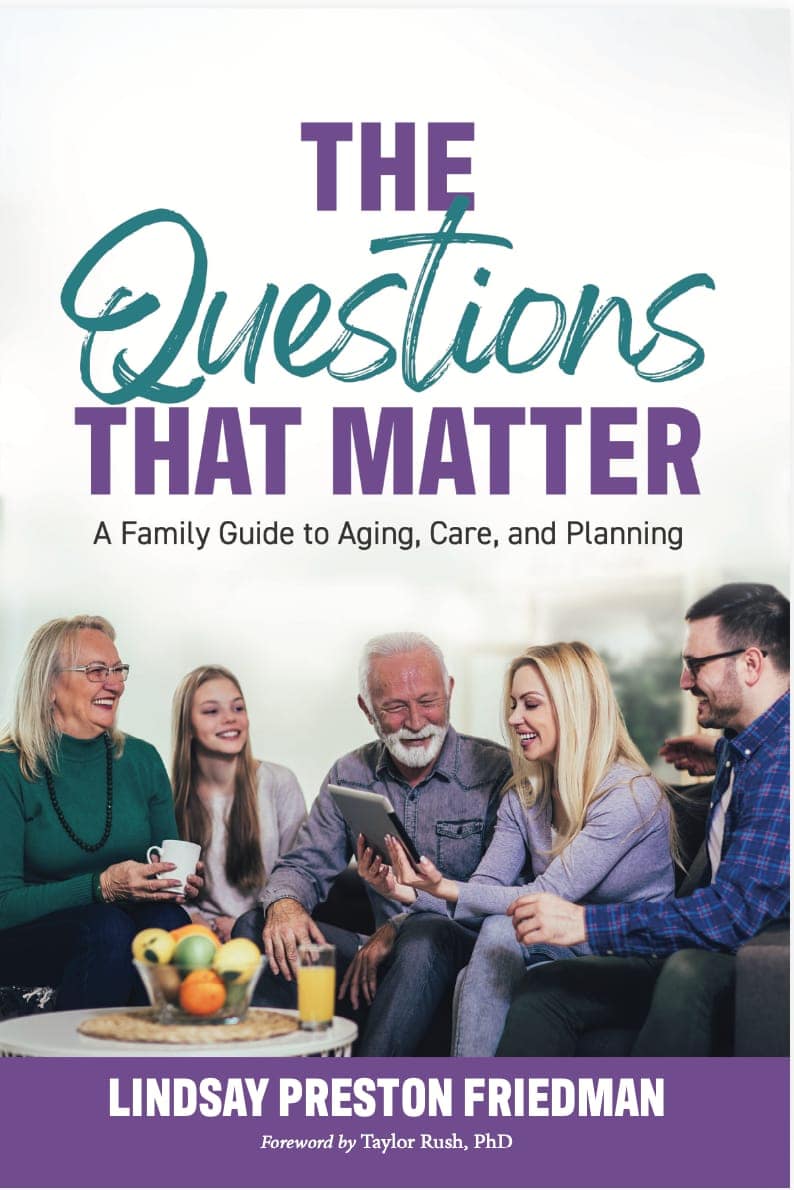
Every card is a doorway. The Questions That Matter: A Family Guide to Aging, Care, and Planning is the full guide behind the deck — the chapter, the context, and the next conversation for every prompt you've already started at the table.
Reading the answer is one thing — knowing what it means for your family is another. Get a free, personalized Care Plan in minutes. No pressure, no sales calls, just the next right step for where you are today.