
The One-Sentence Version
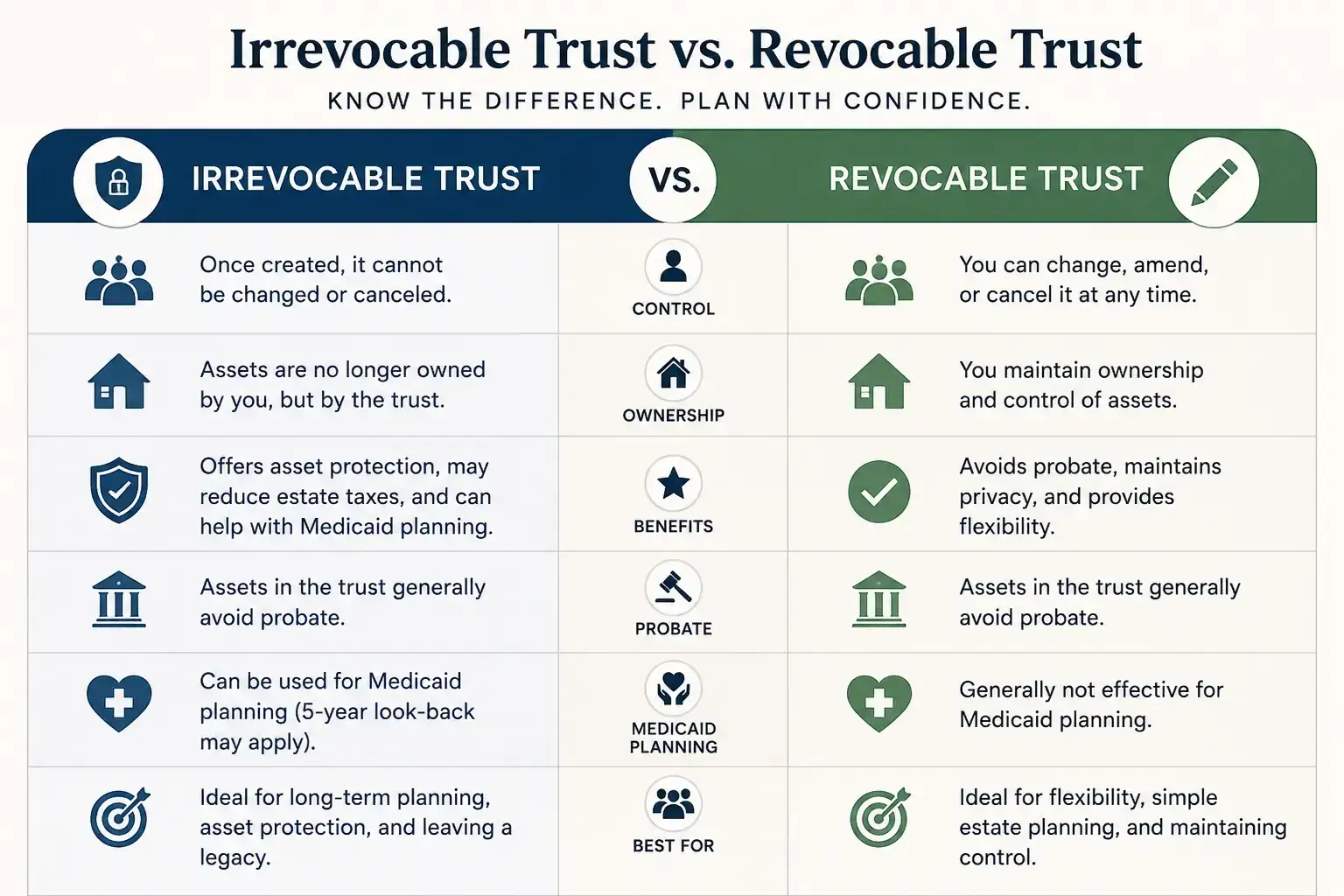
A revocable trust is one you can change or cancel anytime. An irrevocable trust is one you generally can't.
That single fact — can you undo it or not — drives every other difference between them.
Revocable Living Trust: You Stay in Charge
With a revocable trust, you're usually the trustee. You can add assets, remove them, change beneficiaries, or dissolve the whole thing whenever you want. Nothing is locked.
What it's good for:
- Avoiding probate on your estate
- Keeping your affairs private (probate is public record; a trust isn't)
- Naming a successor trustee to step in if you become incapacitated
What it does NOT do:
- Protect assets from creditors
- Protect assets from nursing home costs
- Reduce your taxable estate
Because you still control it, the law still treats those assets as yours. Medicaid counts them. Creditors can reach them. If your goal is asset protection for long-term care, a revocable trust doesn't get you there.
Irrevocable Trust: You Give Up Control
With an irrevocable trust, you transfer assets out of your name and generally can't take them back. A trustee — someone other than you — manages them under rules you set up front, before you handed over control.
What it's good for:
- Protecting assets from Medicaid's asset limits (after the 5-year lookback period)
- Removing assets from your taxable estate
- Protecting assets from creditors and lawsuits
- Controlling how and when heirs receive an inheritance
What it costs you:
- You typically can't change your mind
- You lose direct access to and control over the assets
- It takes 5 years for Medicaid to stop counting a transferred asset against you
- It's more expensive to set up and requires ongoing attorney or trustee involvement
Side-by-Side
| Feature | Revocable Trust | Irrevocable Trust |
|---|---|---|
| Can you change it? | Yes, anytime | Generally no |
| Who controls assets? | You | A separate trustee |
| Avoids probate? | Yes | Yes |
| Protects from Medicaid spend-down? | No | Yes, after 5-year lookback |
| Protects from creditors? | No | Yes |
| Reduces taxable estate? | No | Yes |
| Cost and complexity | Lower | Higher |
The Question That Actually Matters
Don't ask "which trust is better." Ask this instead: Am I trying to organize my affairs, or am I trying to protect assets from a future cost?
If you're organizing — making sure things transfer smoothly, avoiding probate, keeping things private — a revocable living trust probably does the job.
If you're protecting — trying to shield a home or savings from the cost of a nursing home five, ten years down the road — you need an irrevocable trust, and you need to act years before you think you'll need it. The 5-year lookback doesn't forgive procrastination.
A Common Misstep
Families often set up a revocable trust thinking it will protect the house from nursing home costs. It won't. If you're still in control of it, Medicaid still counts it. This is one of the most common and costly misunderstandings in long-term care planning — and it's usually discovered at the worst possible moment, when someone's already applying for benefits.
Bottom Line
Revocable trusts organize. Irrevocable trusts protect. Most people eventually need to think about both — but they solve different problems, and confusing them can cost your family tens of thousands of dollars.
Talk to an elder law attorney before setting either one up. State rules on both vary significantly, and the 5-year lookback means timing is everything.
Sources & references
Verified July 2026- Medicaid.gov: Medicaid Long-Term Services and Supports
- Medicaid.gov: Transfer of Assets — Medicaid.gov
- Internal Revenue Service: Estate and Gift Taxes
- NAELA: National Academy of Elder Law Attorneys
- U.S. Administration for Community Living: Administration for Community Living
This article is for educational purposes only and does not constitute legal advice. Trust rules, Medicaid treatment, and tax implications vary significantly by state. Consult a licensed elder-law attorney for guidance specific to your situation.